Wot Dots - Strategic Navigation
Setting up for Transformation success - back to the future

The fortnightly newsletter (it is finally now launched now, after the first ‘beta’ test. Thank you to everyone who gave feedback) that spots the dots, draws patterns and makes insight. As a senior leader myself I meet with executives across all sectors. My curiosity in patterns across organisations and my role mean that I get to hear a lot (the dots) and start to see themes (patterns) that we all can learn from (insights). This newsletter shares what I deem is worthwhile. I thank you for subscribing.
The Dots
Wind back the clock to 1997, in London, when I led a team at Andersen Consulting (now Accenture) tasked with ‘finding the secret sauce’ as to why some programs were vastly more successful than others (shhh – yes some Andersen projects were not rosie). The secret sauce had a key ingredient. It was simply that senior executives strategically navigated the change, not just sponsored nor led it. So, what does strategically navigate mean? It is the executive team jointly owning the transformation and proactively seeking ‘good’ information to make course corrections and adjustments throughout, as opposed to simply turning up at Steering Committee sessions. The Steering Committee was just one source of information. Think of it like a strategic Board for the Transformation. This puts it in a different frame of reference from other forms of program governance.
Now wind the clock forward to August 2025. I have met with Director Generals of Government agencies, renewables and tech companies, where the same Dots keep surfacing around a question like this “how do we set up to get all our key changes in place, whilst keeping BAU going, and also retaining our culture and frontline goodwill”.
This 2025 statement is all about strategic navigation of change. My sense is that the need has always been there, but it has now risen again to be a critical business imperative. Organisations today accept that change is normal, but more than ever, they must keep a laser focus on cost and demonstrated outcomes. Leaders can no longer rely solely on program management as the trusted vehicle for success.
So Wot to do?
Let’s keep it simple, practical and to the point. This is not advocating the replacement of project or program management. Those disciplines are needed, but their focus is narrower, and on a specific project or coordinated group of projects/work streams under a single program. Strategic navigation is about the enterprise-wide orchestration of often disparate and/or complex changes that need to come together and align to achieve sustained strategic outcomes and true transformation. Examples could be (a) a strategic shift to AI as a core capability throughout an organisation, or (b) acquisition and integration of a business larger in scale than the acquirer. As a thumb nail – when 60%+ of the business is changing, then Strategic Navigation is required.
Call to action - If you are embarking on transformation, consider the list below. Experience says that about 80% of the following need to be in place to confidently proceed with complex large-scale change. Feel free to add more to this list, for your unique circumstances.
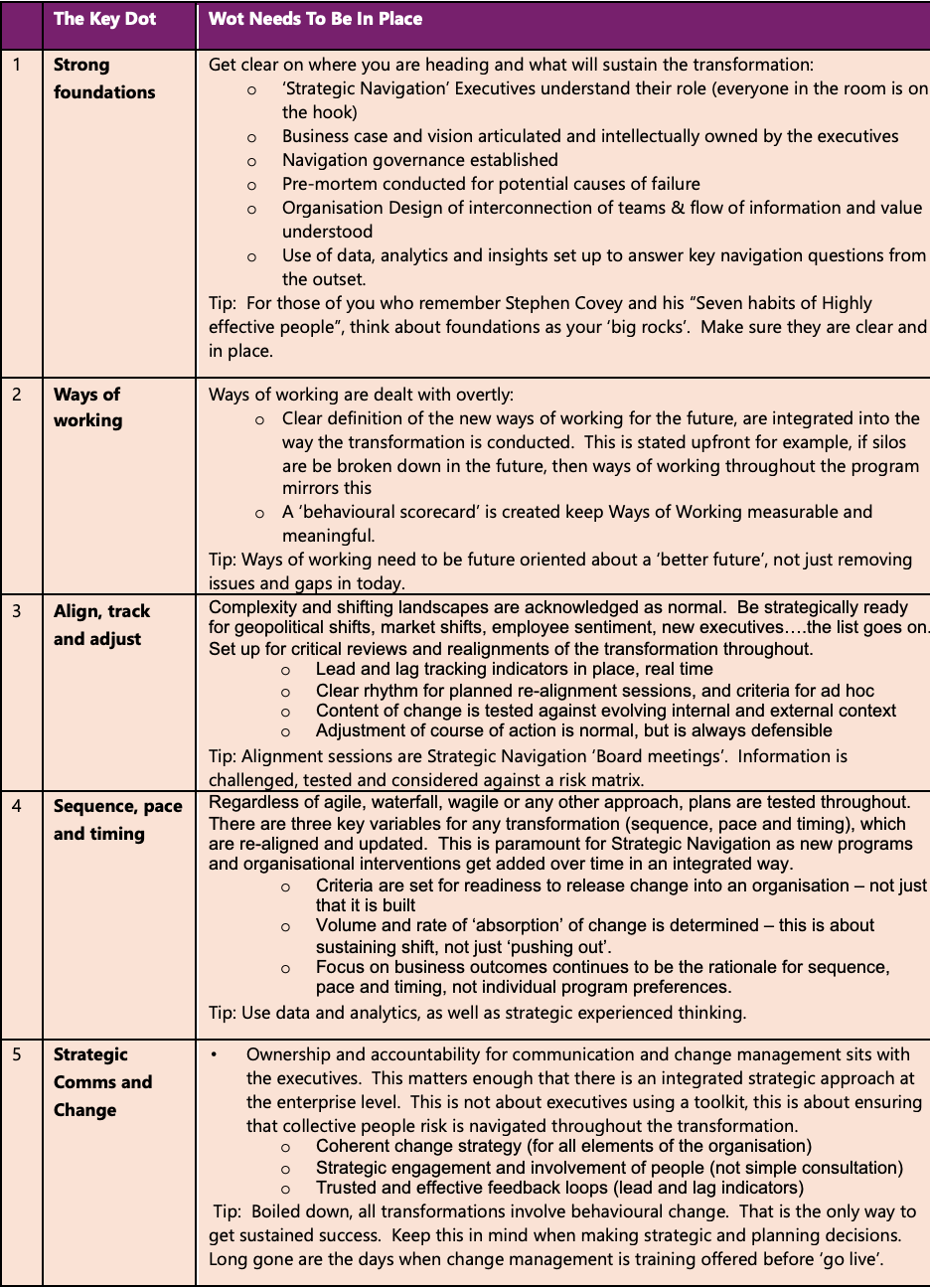
Yes, this is a long list to consider, but making significant transformation successful matters.
So Wot Reality Check
– Yep – but organisation life is not that straight forward.
Transformation can go off the rails. We all know it. So do what do you do if your organisation is underway with dozens of programs, all competing for air time, and with different sponsors, all with their own KPIs (and linked bonuses in some cases)? The Chief Executive is the one who needs to intervene. This is all about risk and business outcomes. Informing upwards effectively or Board direction could trigger this.
Of course, there is advantage in including the above factors within program stage gates/review points, for program level improvement. But Strategic Navigation needs to bring all critical programs under one strategic umbrella. A symbol in new ways of navigation change could be in the establishment of a ‘Strategic Delivery Office’. Remember this is not built by program managers for integrated program management. Strategic Navigation is executive decision making.
I am always happy to share. Feel free to DM on LinkedIn if you would like to know more.
More Wot Not –
only read this section if you want some more background on the Wot
Scoping, shaping and delivering transformation well is an imperative. But we know three things:
- Behavioural change is central to success
- In general, human behaviour regresses towards the mean
- Old ways get baked in and self-reinforce making it difficult to pull away from the ‘vortex’.
True transformation takes considerable effort, will and strategic navigation. I have recently been introduced to Ken Rickard’s Vortex of Behavioural Pattern model (https://bit.ly/4lNRMrN). It is a tool that could be used by the Strategic Navigation executives to reconcile why change might be sticking. In summary, the model, see below, considers:
- Systemic inputs and outputs
- Strategy
- Leadership and culture
- Attitudes towards achievement and conformity
- Organisational and leadership maturity.